The United States Enters the Post-Penny Economy
Lessons from the Euro Changeover
On 1 January 2002, twelve countries began using the same banknotes and coins. Austria, Belgium, Finland, France, Germany, Greece, Ireland, Italy, Luxembourg, the Netherlands, Portugal and Spain, a population the European Central Bank put at 308 million, shared a single cashMoney in physical form such as banknotes and coins. More currencyThe money used in a particular country at a particular time, like dollar, yen, euro, etc., consisting of banknotes and coins, that does not require endorsement as a medium of exchange. More for the first time.
The transition did not begin that morning. BanknoteA banknote (or ‘bill’ as it is often referred to in the US) is a type of negotiable promissory note, issued by a bank or other licensed authority, payable to the bearer on demand. More production started in July 1999 across fifteen printing works. By launch, an initial supply of 14.89 billion banknotes with a face valueThe figure or amount written on the banknote or coin which indicates the amount of its economic value. It is usually written in letters and numbers. More of some 633 billion euroThe name of the European single currency adopted by the European Council at the meeting held in Madrid on 15-16 December 1995. See ECU. More had been printed, alongside roughly 52 billion coins worth 15.75 billion euro, produced at sixteen mints using around 250,000 tonnes of metal. Frontloading to banks ran from September 2001, followed by sub-frontloadingto retailers and vending operators. An information campaign costing 80 million euro ran across eleven languages. Dual circulation ended and the euro became sole legal tenderMoney that is legally valid for the payment of debts and must be accepted for that purpose when offered. Each jurisdiction determines what is legal tender, but essentially it is anything which when offered (“tendered”) in payment of a debt extinguishes the debt. There is no obligation on the creditor to accept the tendered payment, but the act of tendering the payment in legal tender discharges the debt. More on 1 March 2002, by which point more than 6 billion national banknotes and close to 30 billion national coins had been withdrawn.
A recent conversation with Guillaume Lepecq of CashEssentials, reinforced an important lesson from that experience: changing currency is not simply a monetary-policy decision. It is an implementation exercise. Making it work required central banks, commercial banks, cash-in-transit operators, retailers and vending companies to move in sequence, on a published schedule, under rules agreed years in advance.
Even that degree of coordination did not eliminate every complication. The clearest example was price perception. Eurostat’s initial assessment, published on 28 February 2002, concluded that the changeover effect on the month-on-month increase in euro-area consumer prices between December 2001 and January 2002 most likely fell within a range of 0.0% to 0.16%, with non-euro factors, including severe winter weather and tobacco tax rises, explaining a larger share. Eurostat has since described such changeover effects as noticeable in certain categories but not of a magnitude that could drive headline inflation. Consumers saw it differently. In Germany the new currency acquired the nickname “Teuro” a play on teuer, meaning expensive, and measured inflation and perceived inflation diverged for years afterwards. Planning does not remove complexity. It shapes how the changeThis is the action by which certain banknotes and/or coins are exchanged for the same amount in banknotes/coins of a different face value, or unit value. See Exchange. More is experienced, and the gap between what statistics record and what the public believes is itself something to manage.
The Penny: One Currency Twenty Rulebooks
The United States is now undergoing a far smaller denominationEach individual value in a series of banknotes or coins. More change through a very different operating model. On 12 November 2025 the US MintAn industrial facility manufacturing coins. More struck the final one-cent coinA coin is a small, flat, round piece of metal alloy (or combination of metals) used primarily as legal tender. Issued by government, they are standardised in weight and composition and are produced at ‘mints’. More produced for general circulation in Philadelphia, ending a 232-year production run. Treasury acted under existing authority at 31 U.S.C. 5111 and 5112, which allows the Secretary to mint coins in the quantities commerce requires; the Mint reported that the cost of producing a penny had risen over the previous decade from 1.42 cents to 3.69 cents. The penny remains legal tender. Existing coins were neither recalled nor demonetised. Production has ended while the operating framework around it continues to develop.
The difference is structural rather than a question of diligence. No single national rulebook is yet in force, although Congress has now passed one. Separate versions of the Common Cents Act cleared one chamber each over the summer: H.R. 3074 passed the House on 14 July 2026 and S. 1525 passed the Senate on 7 August. Athird vehicle, H.R. 10167, passed the House on 14 September and the Senate, without amendment, on 28 September. As of 29 September it awaits presentation to the President and is not law. If enacted, it would permit, but not require, a person to round a cash transaction to the nearest five cents when exact change cannot be provided, and would provide that a person adhering to those rounding provisions is not in violation of state, tribal or local requirements on that basis. The bill contains no provision repealing existing state laws. How existing state requirements interact with those federal provisions is now part of the implementation question.
Twenty states have enacted cash-rounding frameworks in the meantime, and their rules differ in scope as well as method. Arizona’s statute is distinctive in prohibiting any rounding method other than the one it prescribes. Minnesota’s authority reaches state agency transactions rather than general retail. California signed SB 1005 on 18 September 2026, an urgency statute effective immediately, permitting a qualifying local agency to round cash payments made to it and cash amounts it tenders, but only after its governing body adopts a majority-vote resolution. It is not a statewide merchant rule. A separate California measure requiring merchant rounding from,July 2027 was presented to the Governor in late August and, as of 29 September, had not been enacted. Jurisdiction alone does not answer the question. Actor, transaction direction, legal authority, effective dateThe year in which a medal or coin was minted. On a banknote, the date is usually the year in which the issuance of that banknote - not its printing or entering into circulation - was formally authorised. More and activation status can each matter.
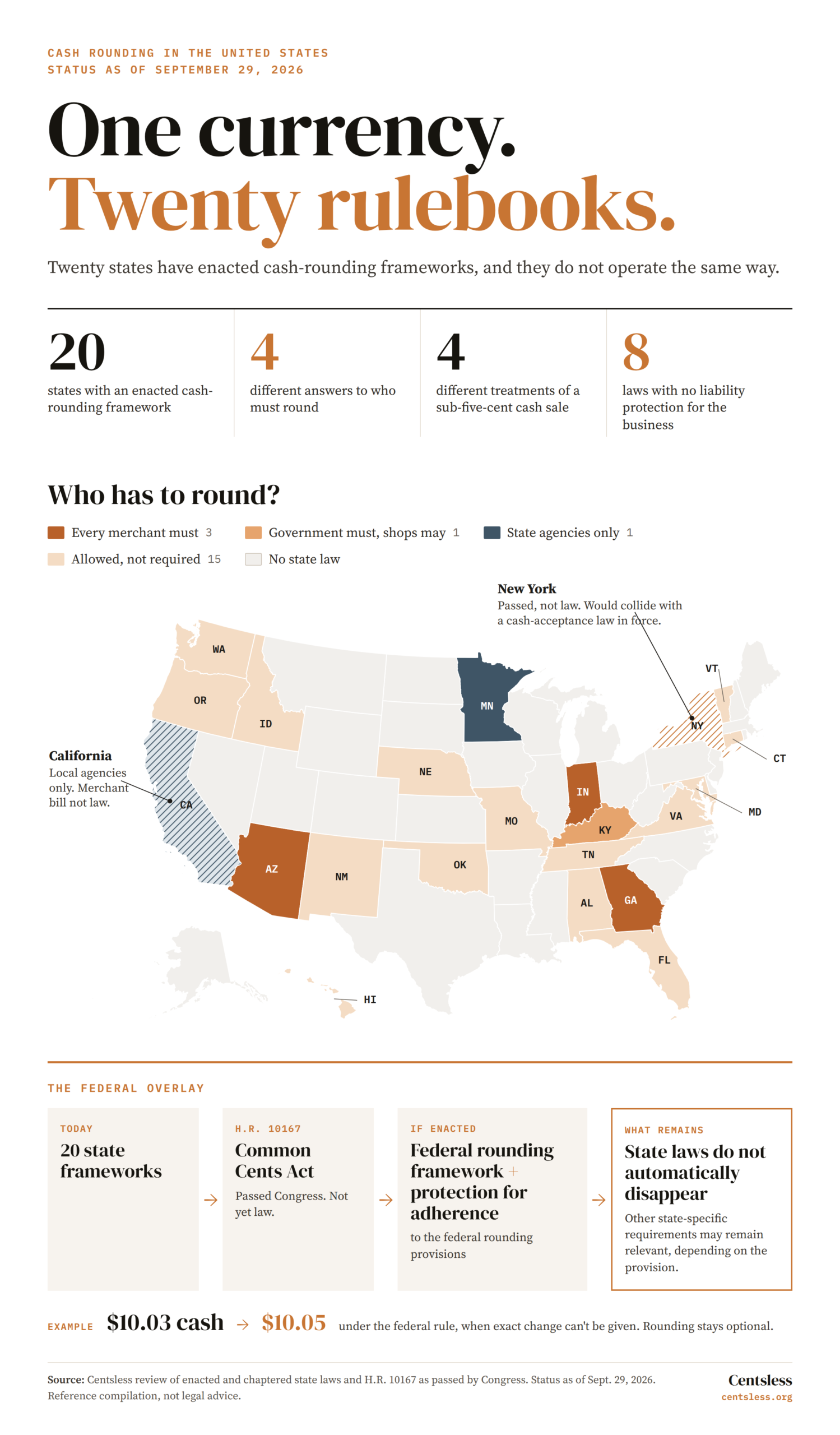
One further structural feature: in most American jurisdictions displayed prices exclude sales tax, which is added at the registerSee See-through register. More, whereas consumer prices across much of Europe are VAT-inclusive. The amount subject to rounding is therefore the post-tax total rather than the shelf price, so the rounded figure cannot be derived from the label. Rounding logic has to sit in the transaction.
The arithmetic is the easy part. Rounding to the nearest five cents is trivial. The harder problem is knowing when that calculation is allowed to run, which rule governs it, and being able to explain later why a transaction was handled a particular way.
Within one retail estate, that determination may turn on governing authority, jurisdiction, actor, transaction type, tender type, paymentA transfer of funds which discharges an obligation on the part of a payer vis-à-vis a payee. More direction, effective date and activation condition. Canada, Australia and New Zealand each paired coin withdrawal with advance guidance and merchant preparation. The American challenge is not the mathematics. It is applying rules that are still evolving. Congress has moved toward a national framework, but a business will still need to determine when that framework applies, how it sits alongside the requirements of each state in which the business operates, and how either translates into an individual transaction.
That implementation gap is where Centsless is working. The company is building jurisdiction-aware transaction compliance infrastructure, beginning with cash rounding. It does not replace the point of sale. Its role is to determine which rule applies to a transaction, whether that rule is federal, state or local, apply the current rule, and preserve the authority and context behind that decision.
The lesson from previous currency transitions is not that every country should follow the same model. It is that denomination change does not end with the decision to stop producing a coin. It begins there. The United States has entered that phase now. The penny may be disappearing from production, but the post-penny operating system is still being built. The denomination may change. The rules may change. The transaction still has to be right.
S O U R C E S
European institutions
European Central Bank, “Initial changeover (2002).” ecb.europa.eu/euro/changeover/2002. Banknote and coin production volumes, frontloading timeline, quality coordination, and the 1 March 2002 end of dual circulation.
European Central Bank, Evaluation of the 2002 Cash Changeover, April 2002. ecb.europa.eu/pub/pdf/other/cashchangeoverreport2002en.pdf. Sub-frontloading to retailers and other eligible parties.
European Central Bank, speeches on the Euro 2002 Information Campaign: Willem F . Duisenberg, 17 September 2001; Eugenio Domingo Solans, 13 November 2003. Campaign budget and language coverage.
Eurostat, news release STAT/02/23, 28 February 2002, “Euro-zone annual inflation up to 2.7%: euro changeover effect likely to be within the 0.0% to 0.16% range.” ec.europa.eu/commission/presscorner/detail/en/stat_02_23. The cited range applies to the month-on-month HICP increase between December 2001 and January 2002.
Eurostat, euro changeover and inflation notes for Cyprus and Malta (2008), Estonia (2011) and Croatia (2023), each of which references the first-wave 2002 changeover as comparator and characterises changeover effects as noticeable but not of a magnitude that could drive headline inflation. ec.europa.eu/eurostat.
United States, federal
United States Mint, “United States Mint Hosts Historic Ceremonial Strike for Final Production of the Circulating One-Cent Coin,” 12 November 2025. usmint.gov.
United States Mint, Penny FAQs. usmint.gov/news/media-kit/penny. Production cost figures.
United States Department of the Treasury, “Penny Production Cessation FAQs.” home.treasury.gov. Statutory authority at 31 U.S.C. 5111 and 5112, and confirmation that the penny remains legal tender.
Congress.gov and GovInfo, 119th Congress: H.R. 3074, S. 1525 and H.R. 10167, bill texts and action histories. H.R. 10167 introduced 27 August 2026; passed the House 14 September 2026; received and referred to the Senate Committee on Banking, Housing, and Urban Affairs 15 September 2026; committee discharged and bill passed the Senate without amendment by unanimous consent 28 September 2026. Status through 29 September 2026: awaiting presentation to the President. Provisions described are from the text as passed by the House (GovInfo BILLS-119hr10167eh), which the Senate passed without amendment, principally sections 3(a), 3(e) and 4(b). No enrolled version had been published on GovInfo as of 29 September 2026.
United States, states
Arizona State Legislature, HB 2938 engrossed text. azleg.gov/legtext/57leg/2R/bills/HB2938H.pdf. Prohibition on rounding methods other than the prescribed method.
California Legislative Information, SB 1005 and AB 1793. leginfo.legislature.ca.gov. SB 1005 chaptered as Chapter 321, Statutes of 2026, 18 September 2026, urgency statute effective immediately.
Minnesota Revisor of Statutes and Minnesota House Public Information Services. State agency scope of the Minnesota rounding authority.
Centsless, National Cash Rounding Legislative Observatory, centsless.org. Count of twenty enacted state cash-rounding frameworks, each read from the enacted, enrolled or chaptered act; California SB 1005 is tracked separately as a local-agency authority.
Other jurisdictions
Government of Canada, Budget 2012 and Department of Finance rounding guidelines. budget.canada.ca; canada.ca.
Royal Australian Mint, ramint.gov.au; Reserve BankSee Central bank. More of New Zealand, rbnz.govt.nz.