The Role of High Denomination Notes – Myths and Facts
Every now and then the role of high-denomination banknotes is criticized by claiming that their use is only for criminal and tax evasion purposes. Recently, author Oliver Bullough did this in his book ‘Everybody Loves Our Dollars – How money launderingThe operation of attempting to disguise a set of fraudulently or criminally obtained funds as legal, in operations undeclared to tax authorities, and therefore not subjected to taxation. Money laundering activities are strongly pursued by authorities and in most countries, there are strict rules for credit institutions to cooperate in the fight against money laundering operations, to declare and report any transactions that could be considered suspicious. More won’ published in January this year. Bullough’s book consists of 12 chapters addressing different forms of moneyFrom the Latin word moneta, nickname that was given by Romans to the goddess Juno because there was a minting workshop next to her temple. Money is any item that is generally accepted as payment for goods and services and repayment of debts, such as taxes, in a particular region, country or socio-economic context. Its onset dates back to the origins of humanity and its physical representation has taken on very varied forms until the appearance of metal coins. The banknote, a typical representati... More laundering, one of them dedicated to banknotes.
In the banknoteA banknote (or ‘bill’ as it is often referred to in the US) is a type of negotiable promissory note, issued by a bank or other licensed authority, payable to the bearer on demand. More chapter, Bullough notes that “In pretty much every country on earth, cashMoney in physical form such as banknotes and coins. More is being quickly or slowly outcompeted by electronic paymentA transfer of funds which discharges an obligation on the part of a payer vis-à-vis a payee. More methods”, and calls banknotes “an analogue technology in a digital age (pages 110−111). He continues, “that ordinary citizens are not demanding banknotes” (p112). Therefore, it’s not surprising that his fixed idea is that cash in circulationThe value (or number of units) of the banknotes and coins in circulation within an economy. Cash in circulation is included in the M1 monetary aggregate and comprises only the banknotes and coins in circulation outside the Monetary Financial Institutions (MFI), as stated in the consolidated balance sheet of the MFIs, which means that the cash issued and held by the MFIs has been subtracted (“cash reserves”). Cash in circulation does not include the balance of the central bank’s own banknotes (as... More is increasing only because of its use for criminal purposes, and the evil is in the printing of high denominationEach individual value in a series of banknotes or coins. More banknotes.
Bullough even claims that central banks are issuing high denomination notes due to seigniorage: “This revenue stream is what funds central banks, allowing them to assert their independence. Obviously, central banks do not want to lose that income…” (p125).
As the subtitle of the book indicates, Bullough has great concerns about the current solutions to prevent money laundering and concludes the book with a passage titled “We Can Do Better”. His foremost solution to stop money laundering lies in the wealthy, mainly G7 countries.
He writes “If there is one changeThis is the action by which certain banknotes and/or coins are exchanged for the same amount in banknotes/coins of a different face value, or unit value. See Exchange. More I would make in all of those countries, it would be to stop them from printing high-denomination banknotes. I know some people think that the existence of the $100 bill, the €200 note or the £50 note is an important safeguard against government intrusion into our private lives but, while supposedly fulfilling that theoretical role, they are in reality enabling criminal misdeeds on a vast scale. What non-criminals would honestly be inconvenienced if the largest US banknote was a $20 bill? Would the fascism really return to Germany if the €200, €100 and €50 banknotes would be retired?” (p272−273)
The purpose of the following study is not to argue that banknotes are not used for criminal or tax evasion purposes. It is evident that when cash transactions don’t leave a trace, they are practical for that. However, to explain the movements of cash in circulation with such a hypothesis is a myth not based on any serious analysis.
In his conclusions Bullough also emphasizes that “We need data, and that data need to be analysed” (p. 280). Given that some data has escaped Bullough’s attention in compiling his book, the role of the high denomination notes is indeed worth of an analysis.
Overview of high-end banknotes issued by central banks
Let us start with a global overview on the high-end notes of various currencies. Figure 1 illustrates the value breakdown of high-end notes of 149 currencies. The horizontal axis is divided in brackets in accordance with the value of the high-end note in euros and the vertical axis indicates the number of currencies having the high-end note inside a certain range. A couple of already mostly withdrawn high-end notes are not included.
Figure 1. Value breakdown of high-end banknotes, 149 currencies[1]
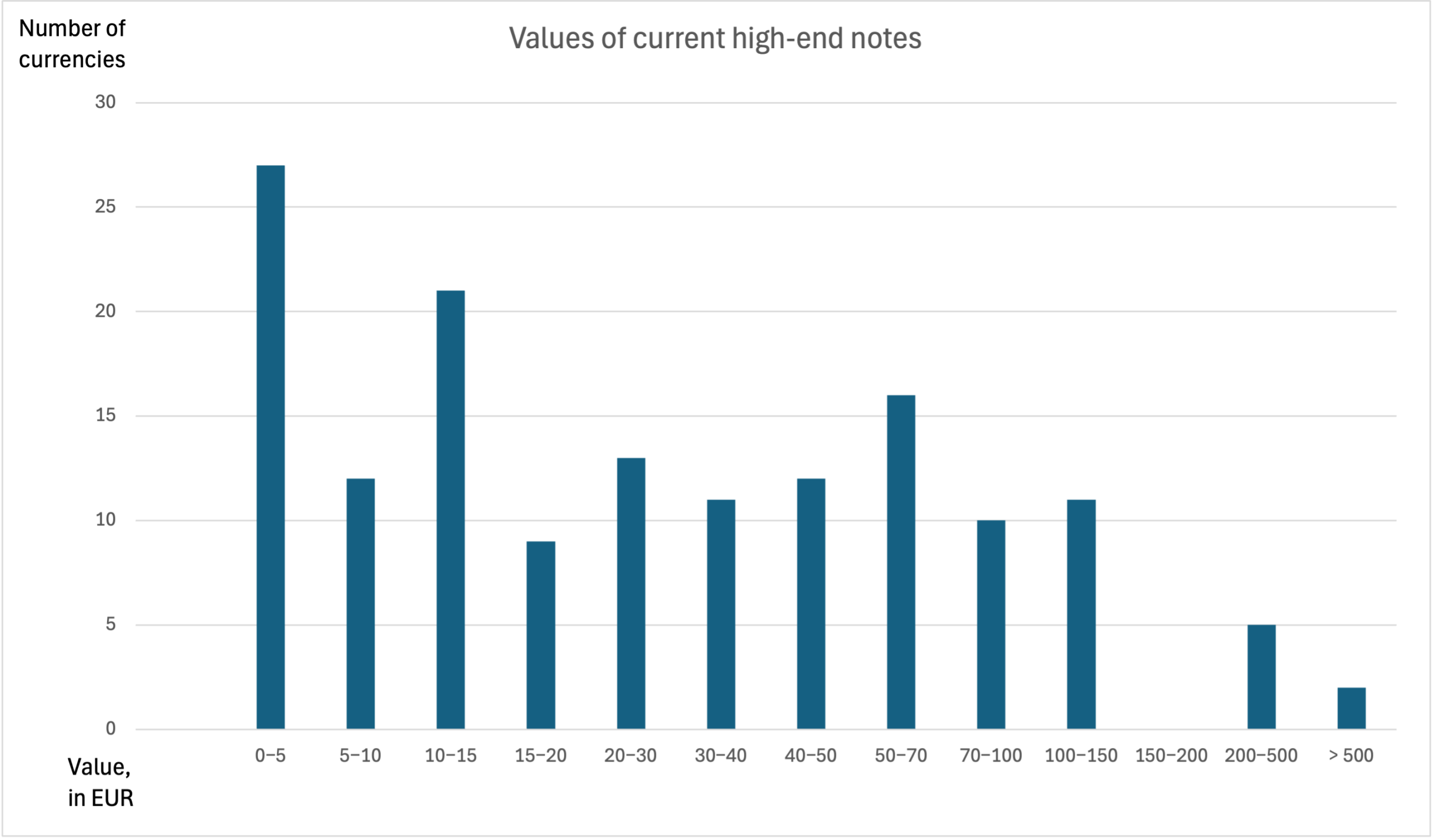
The distribution of Figure 1 is really striking. It is surprising to discover the low values of the high-end notes of most currencies. For more than 45% of the currencies, the value of the high-end note is less than €20, and for more than 70% less than €50. Only 18 currencies have a high-end note that is over €100.
The low value of the majority of high-end notes might explain why the US dollarMonetary unit of the United States of America, and a number of other countries e.g. Australia, Canada and New Zealand. More and euroThe name of the European single currency adopted by the European Council at the meeting held in Madrid on 15-16 December 1995. See ECU. More notes are so popular outside the USA and euro area. If people would like to use banknotes as a store of valueOne of the functions of money or more generally of any asset that can be saved and exchanged at a later time without loss of its purchasing power. See also Precautionary Holdings. More, and domestic notes are not proper for the purpose, they would most probably prefer notes that are widely accepted. Moreover, in highly inflationary or unstable circumstances domestic banknotes are mainly used for daily purchases, and more stable currencies are used for saving purposes.
Figure 1 indicates that central banks do not build the denominational structure of their notes due to seigniorage but based on the efficiency of the payment system in all circumstances, also for unforeseen events.
This argument on unforeseen events was highlighted recently by the Norges Bank[2], when it decided that banks can no longer order new 1000-krone notes. However it underlined that they can be put back into circulation, if necessary, for example in an emergency.
In a severe crisis, the ability to move large amounts of cash quickly is important, and then high-denomination notes are indispensable as shown later in this article.
Introduction of new high-end notes
If Figure 1 doesn’t convince the reader that it is a myth that high-denomination notes are issued for seigniorage purposes, it is worthwhile to look at the introduction dates of the current high-end notes.
Figure 2 illustrates the dateThe year in which a medal or coin was minted. On a banknote, the date is usually the year in which the issuance of that banknote - not its printing or entering into circulation - was formally authorised. More of introduction of the high-end note of 149 currencies. The horizontal axis refers to the year/period of introduction of the current high-end note and the vertical axis indicates the number of current high-end notes introduced during a certain year or period.
Figure 2. Years/periods of introduction of current high-end notes, 149 currencies
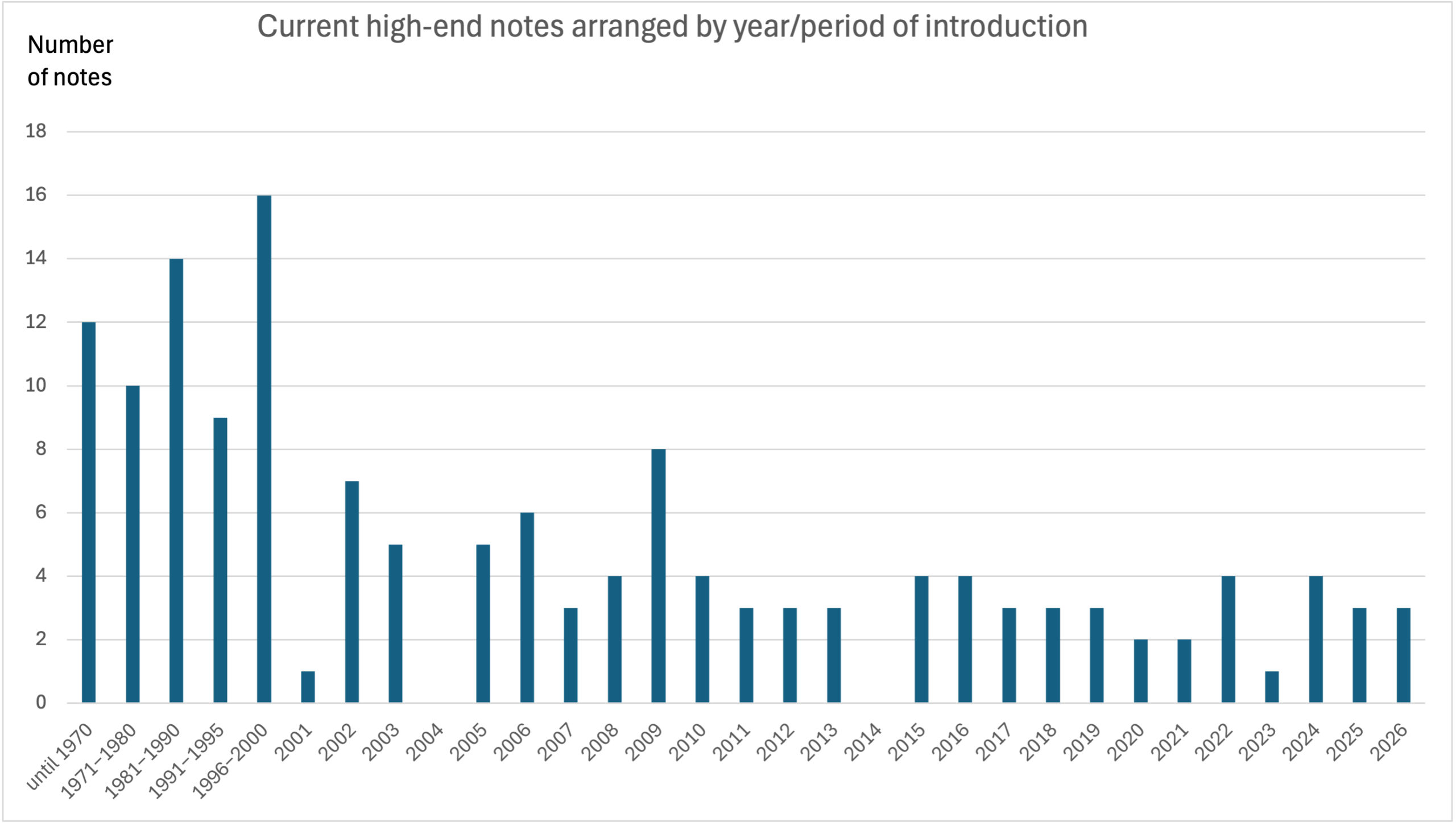
According to Figure 2, central banks seem to be very conservative in introducing new high-end notes. The median introduction year of current high-end notes is 2005. Consequently, it is at least 21 years since half of the issuing central banks introduced a new high-end note.
There are even central banks which haven’t changed the high-end note since the introduction of the monetary unit after independence of the country. So, it is evident that the purchasing power of most high-end notes have significantly decreased since their introduction.
Furthermore, none of the countries mentioned by Bullough explicitly or implicitly in the passage mentioned above (p. 272−273) has issued a new high-end note since 2002 (this year is selected because of the introduction year of euro banknotes; otherwise the date had been in the 20th century). Some of the countries have even withdrawn a high-end note. This further confirms that seigniorage as a reason for high-denomination notes is false.
Demand for high-denomination notes in wealthy countries and the impact of withdrawing them
When proposing to stop the printing of high-denomination notes, Bullough mentions explicitly the United States, the United Kingdom, Australia, Canada, France, Spain, Germany and the Netherlands.
In the following the movements of banknotes in circulation of the respective currencies (USD, GBP, AUD, CAD and EUR) are studied around the major global crises or great uncertainties during the last 30 years or so. The demand for banknotes around great global uncertainties is selected because they and their aftermaths have created the largest changes in the value of banknotes in circulation.
The first major global uncertainty during this period was around Y2K. At the end of 1999, the uncertainty was related to the functioning of the bank data systems and their ability to address the new millennium. The concerns of the general public led them to withdraw their bank deposits, which peaked the banknote demand during the last couple of weeks of 1999 (see Figure 3).
The vertical axis refers to the growth rates of banknotes in circulation of the five currencies in 1998, 1999 and 2000 (given that euro banknotes were introduced first at the beginning of 2002, German mark (DEM) is used here as a proxy for euro).
Figure 3. Growth rates by value of notes in circulation before and after Y2K, 5 currencies
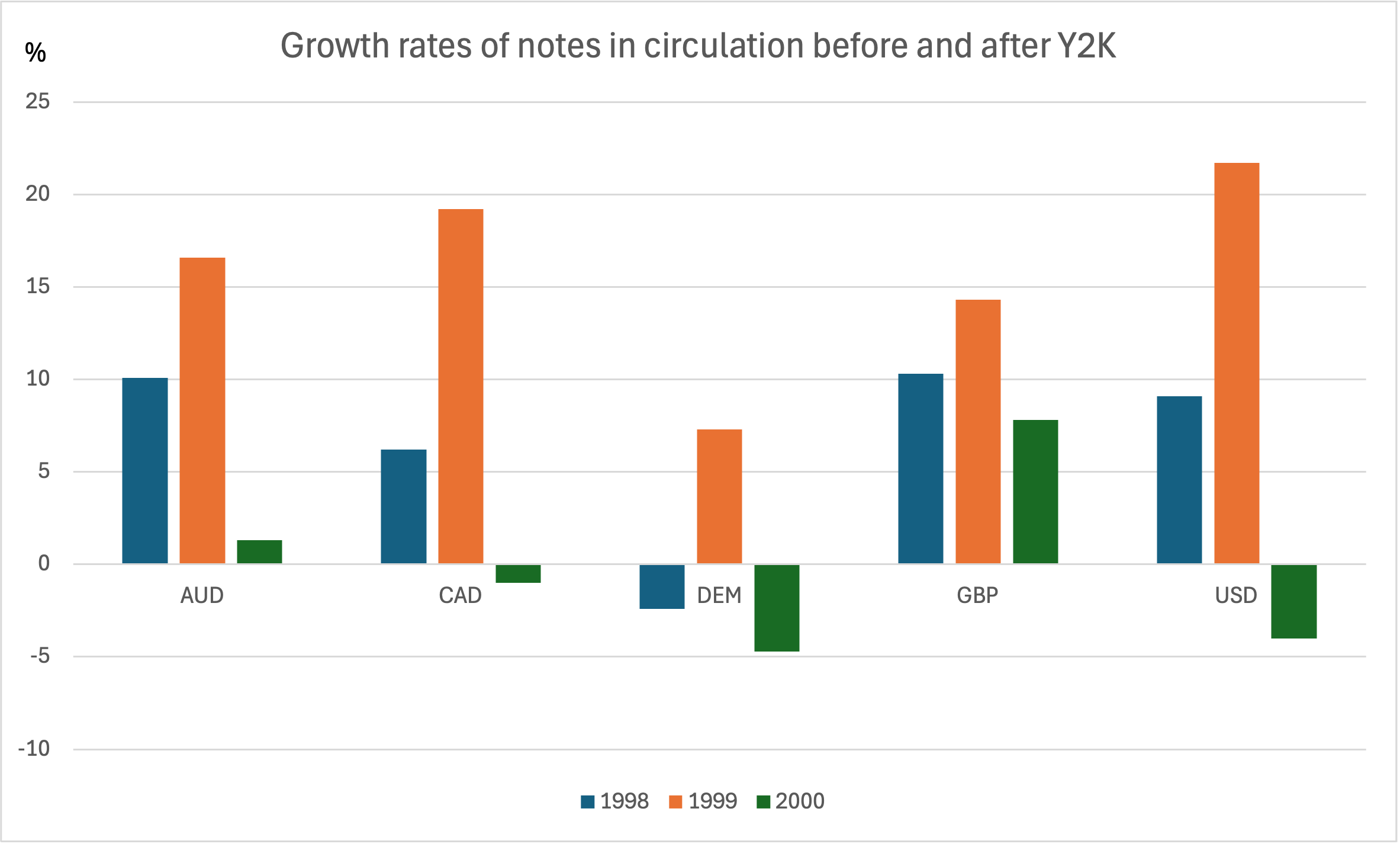
When the banks successfully addressed the “millennium bug,” this one-off uncertainty disappeared, and citizens were ready to deposit their extra cash balances back into bank accounts. This led to even negative annual growth rates by value of banknotes in circulation at the end of 2000.
Such significant changes in banknote demand are explicable only by the behaviour of a great number of citizens, as shown by the following examples.
Let us also play with the thought that the high-end note of US dollar notes had been $20 bill, as suggested by Bullough. At the end of 1999 the annual increase of the $50 and $100 bills was $80,3 billion. If this additional demand would have been obliged to be replaced with $20 bills, it would have required 4,02 billion additional pieces of $20 bills. At the end of 1998 there were in circulation 4,55 billion $20 bills, so it would have been necessary to stockpile almost the same amount, not to speak about the insurmountable logistical problems to transport the notes in a short period (two weeks) to the locations domestically and abroad where they were needed.
Next will follow a similar study around the financial crisis in 2008. Figure 4 shows the growth rates of the five currencies in 2007, 2008, 2009 and 2010.
Figure 4. Growth rates by value of notes in circulation before and after 2008 financial crises, 5 currencies
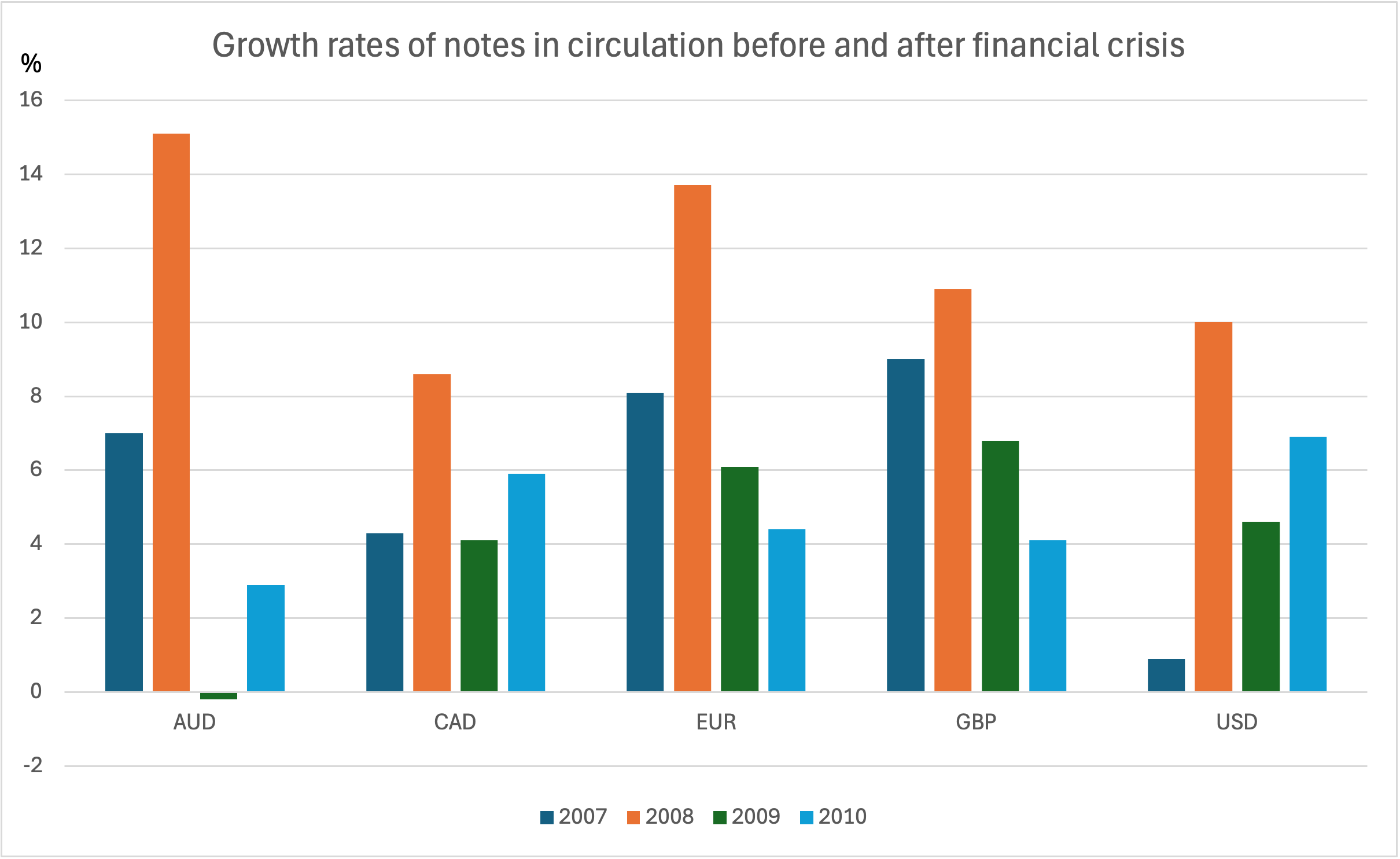
The financial crisis in 2008 had a significant impact on all five currencies under study. The public had concerns related to the collapse of banks, which again led to significant withdrawals of banknotes from bank accounts in 2008.
Using now the Australian dollar for a similar mind-game as US dollar in the earlier example, assuming that AUD 20 had been the high-end note. At the end of 2008 the annual increase of AUD 50 and AUD 100 bills was 6.46 billion dollars. If this additional demand would have been obliged to be replaced with AUD 20 bills, it had required 323 million additional pieces. At the end of 2007 there was in circulation 158 million AUD 20 bills, which would have meant more than doubling the existing amount. Even if the need for additional notes was not so sudden as during the last couple of weeks in 1999, one doesn’t require logistical expertise to understand the impossibility of the delivery.
Thirdly, the demand situation around the Covid-19 pandemic will be examined. The growth rates of the five currencies in 2019, 2020, 2021, 2022 and 2023 are shown in Figure 5.
Figure 5. Growth rates by value of notes in circulation before and after the outbreak of Covid-19 pandemic, 5 currencies
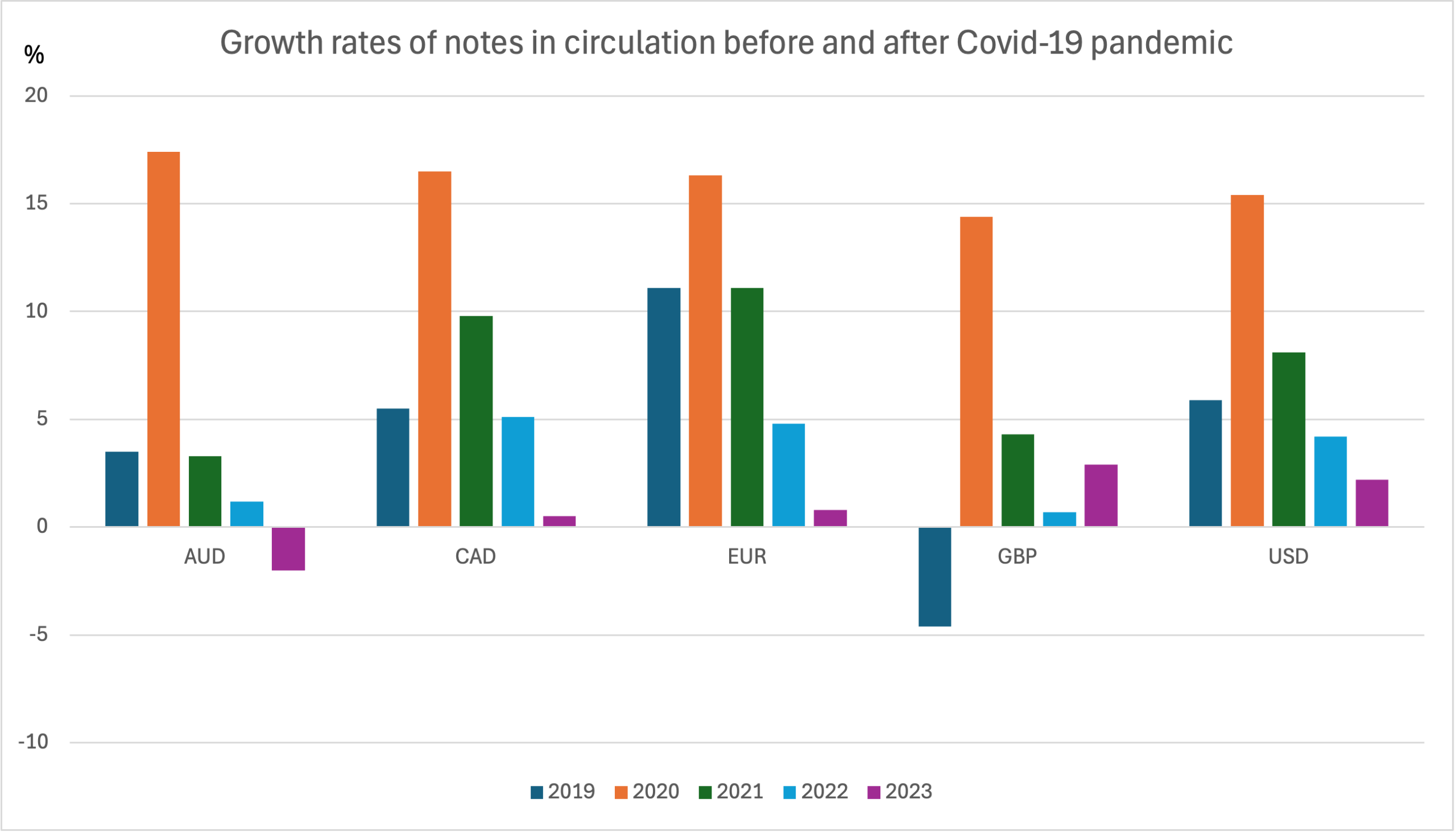
The spread of the virus didn’t occur in all countries at the same time, but it had the greatest impact on the behavior of citizens in 2020, when the vaccines were not yet widely available and travel restrictions and lockdowns were implemented in multiple countries.
The great uncertainty related to the mobility of citizens created an unexpected banknote demand in 2020. At the same time, the restrictions caused by the pandemic had a significant influence on retail shopping and payment habits, creating a growing use of contactless and mobile payments and decreased the use of cash in transactions. The impact on banknote demand was long-lasting, and only as from 2024 (not included in Figure 5), the growth rates of banknote demand have reached a normal level.
Euro banknotes are now used for the mind-game by retiring €50, €100 and €200 notes. At the end of 2020 the annual increase of these three denominations was €155 billion. If this additional demand needed to be met with €20 notes, it had required 7.75 billion additional €20 bills. At the end of 2019 there were in circulation 4.2 billion €20 bills, which would have meant that almost double the existing amount should have been stockpiled/printed and delivered after the outbreak of the pandemic. The numbers speak again for themselves.
Concluding remarks
Irrespective of the development of multiple ways of money laundering, more recently by cryptos and stablecoins, the conception that high-denomination banknotes are the evil remains adamant and hits headlines. The goal of this article is to provide factual data on high-denomination notes and highlight their importance for precaution and as store of value during uncertain times.
Cash is tangible and controlled by the owner, and its use doesn’t require the functioning of other systems. As such, it is the only means of payment that functions if electronic payment systems fail.
The examples show that due to its unique properties, ordinary citizens have placed their trust in cash whether the uncertainty has concerned the millennium and its question marks related to information technology, the financial crisis in 2008 with concerns related to the collapse of banks, or the global spread of a new virus in 2020. Similar examples could be presented on local crises or great uncertainties.[3]
In all these cases banknotes have provided a stabilizing role for the economy in times of crisis or great uncertainty. One can only imagine what kind of panics central banks have prevented by having been able to respond to sudden exceptional demands for banknotes.
To fill this role in the future requires that central banks are not only prepared for exceptional demand for notes with strategic stocks but also that they have high-denomination notes and relevant infrastructure of the cash cycleRepresents the various stages of the lifecycle of cash, from issuance by the central bank, circulation in the economy, to destruction by the central bank. More to ensure the logisticsThe term originates from military language and refers to the movement and provisioning of troops at war. In today’s business vocabulary, it refers to the management in particular, the transportation, storage and distribution of finished goods. More to deliver.
[1] Values of the high-end notes in EUR are based on the exchangeThe Eurosystem comprises the European Central Bank and the national central banks of those countries that have adopted the euro. More rates on 10.8.2026.
[2] Press release 26.4.2026.
[3] E.g. after the Russian aggression in Ukraine began in 2022, there was an unprecedented demand for cash by the public in the neighbouring country Poland. See Report on Cash Circulation in Poland in 2022,
https://nbp.pl/wp-content/uploads/2024/01/Raport-o-obrocie-gotowkowym-EN_2022_WWW.pdf