Four Places Where Cash Should Definitely Be Accepted
In the EU, the US, and in many other countries, the acceptance of cashMoney in physical form such as banknotes and coins. More is under debate. Should cash acceptance be mandated by law? Should it apply to all merchants? Should it be limited to essential goods—and if so, what defines an essential good ? While these questions are discussed in policy circles, there are places where the absurdity of not accepting cash becomes undeniable. Some locations have created situations so illogical, ironic, or exclusionary that they highlight why cash acceptance is not just a matter of tradition or convenience, but of common sense, inclusion, and resilience. Here are four places where cash should absolutely be accepted.
1. The Trevi Fountain: Where Luck Depends on Your Bank App
The Trevi Fountain in Rome is one of the world’s most iconic landmarks, renowned for its cultural and artistic beauty as a masterpiece of Baroque sculpture and architecture. According to tradition, visitors toss a coinA coin is a small, flat, round piece of metal alloy (or combination of metals) used primarily as legal tender. Issued by government, they are standardised in weight and composition and are produced at ‘mints’. More over their left shoulder
- One coin ensures a return to Rome
- Two coins ensure a return to Rome and finding love
- Three coins ensure a return to Rome, finding love, and marriage.
To stand in frontFacade, face. See Obverse. More of a fountain where the entire tradition revolves around throwing coins, visitors must now navigate a digital paymentA transfer of funds which discharges an obligation on the part of a payer vis-à-vis a payee. More system to purchase a €2 ticket. The coins, once tossed, are collected and donated to Caritas, a Catholic charity that supports poor and homeless communities, with an estimated €1.4 to €1.5 million collected annually.
It is hard to imagine the rationale behind this policy. We can suppose that it is not due to a lack of changeThis is the action by which certain banknotes and/or coins are exchanged for the same amount in banknotes/coins of a different face value, or unit value. See Exchange. More. Imagine a remake of Federico Fellini’s La Dolce Vita with Margot Robbie wading into the fountain in a stunning black dress and calling out to her partner, “Marcello, vieni qui con la tua app di pagamento!” (“Marcello, come here with your payment app”).
2. The Berlin Dom: A Masterclass in Payment Absurdity
The Berlin Cathedral (Berliner Dom), a stunning example of Baroque and Renaissance Revival architecture, is a marvel with its grand dome, intricate mosaics, and imperial staircase. However, the cathedral is card-only for entry. You must pay by card to get in. However, once inside, the donation box is banknote-only, and access to the bathrooms is coin-only.
In summary: No cash to enter, but banknotes required to donate and coins to use the bathroom. An extreme model of forced payment diversity.
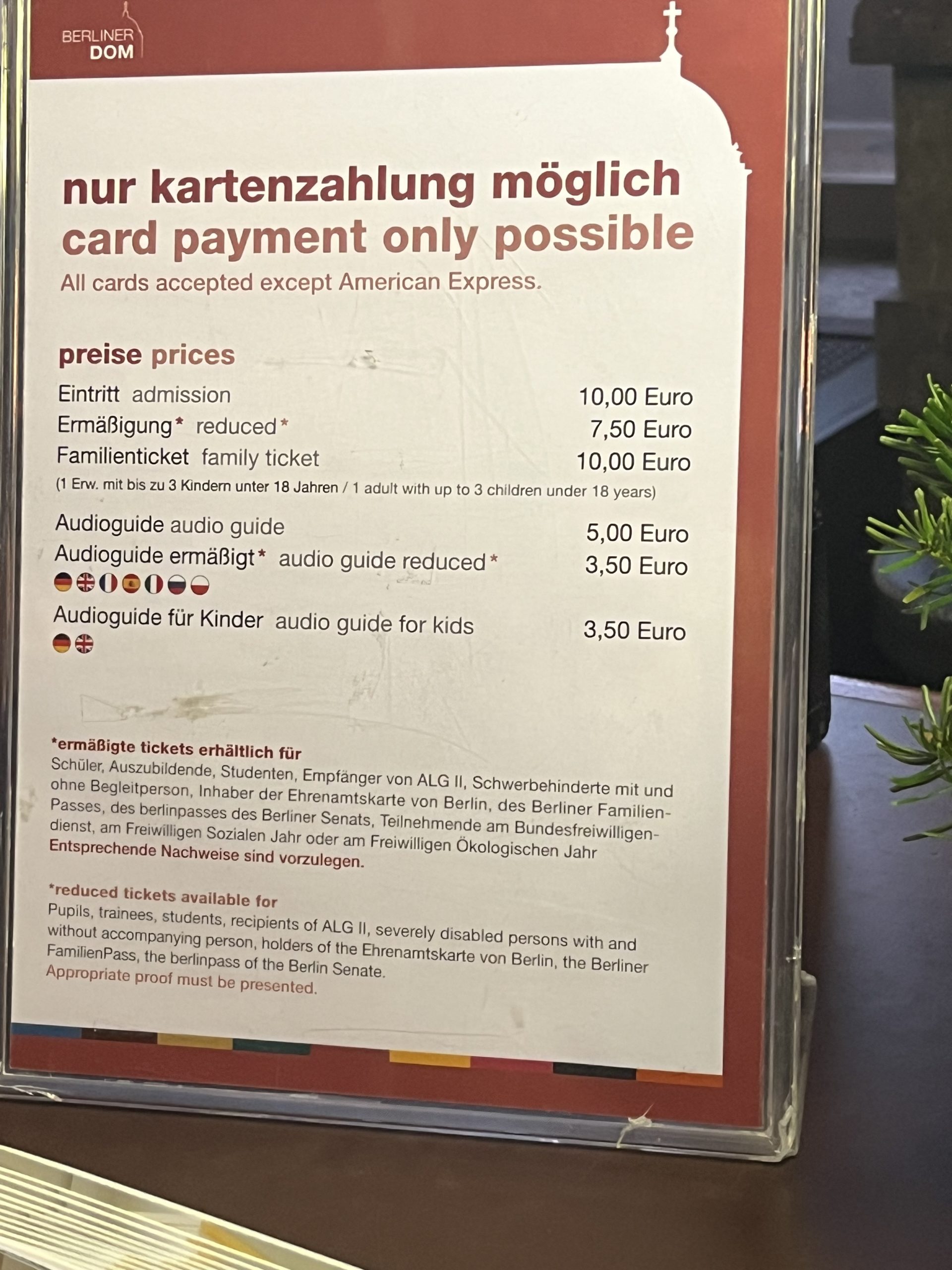
This absurdity calls to mind the 2021 ruling by the EU Court of Justice (Johannes Dietrich and Norbert Häring v Hessischer Rundfunk), where the court ruled that while euroThe name of the European single currency adopted by the European Council at the meeting held in Madrid on 15-16 December 1995. See ECU. More banknotes and coins are legal tenderMoney that is legally valid for the payment of debts and must be accepted for that purpose when offered. Each jurisdiction determines what is legal tender, but essentially it is anything which when offered (“tendered”) in payment of a debt extinguishes the debt. There is no obligation on the creditor to accept the tendered payment, but the act of tendering the payment in legal tender discharges the debt. More, public authorities may limit cash payments for reasons of public interest—such as administrative efficiency—provided such limitations are proportionate. The case was brought by German journalist Norbert Häring, alongside Johannes Dietrich, after Hessischer Rundfunk refused to accept cash for radio and television licence fees. What is the public interest in refusing cash payments at a church?
3. The Paris Metro: A Marvel of Innovation and Absurdity
The Paris Metro, inaugurated on July 19, 1900, was a groundbreaking feat of engineering and innovation. Its iconic Art Nouveau entrances became symbols of the city’s embrace of modernity. Today, the Paris Metro serves over 1.5 billion rides annually making it one of the most used urban transit systems in the world.
However, as many other public transit systems, it has dropped paperSee Banknote paper. More tickets as of June 2026 in favour of a card or phone app. Here’s the twist: In France, cash acceptance is mandatory by law. So, users can top up their transit card with cash at dedicated machines—but they need a payment card to purchase the transit card in the first place.
Yes, you need a card to buy the card that you can then top up with cash. French administration at its best.
4. Sugarloaf Mountain in Rio: A Funicular Fiasco
The Sugarloaf Mountain in Rio de Janeiro offers breathtaking views over one of the world’s most spectacular harbours. Visitors can either take the funicular from the ground level or alternatively walk up to the first level, enjoying a one-hour scenic hike through a tropical forest. To reach the summit however, the only option is to take the funicular. However, the funicular does not accept cash at the first level.
If users can’t pay with a card or with Pix (Brazil’s instant payment system), they are invited to take the funicular back down and pay cash to go back up. While Pix has become ubiquitous, it is not easily accessible for foreigners, for instance. Sugarloaf Mountain attracts approximately 1.5 million visitors annually most of whom come from overseas.
Cash Acceptance is Common Sense
Cash acceptance is about inclusion, resilience, privacy, and civil liberties—and, above all, common sense. It ensures that everyone can fully participate in society. Without cash, people risk being locked out of essential services or experiences simply because they lack a card or smartphone.
The arguments put forward against universal cash acceptance—efficiency, technology, and security—often fall short. These justifications ignore the systemic risks of digital-only systems, such as power outages, cyberattacks, or the loss of anonymity. They also overlook the fact that digital exclusion is a real barrier for many, including the unbanked, elderly, or those without access to modern payment technologies.
The examples above share two key characteristics: they all operate in monopoly situations and provide public goods. From an economic theory perspective, public goods are services that are non-excludable and non-rivalrous, meaning everyone should have access to them without diminishing their availability to others. In such cases, operators should prioritize the public good by ensuring universal accessibility—including the acceptance of cash. If you’re going to charge people to throw coins into a fountain, accept cash. If you’re going to require a card to enter a building but cash to use the bathroom, accept cash. And if you’re going to force someone to ride a funicular down a mountain just to pay, for the love of all that is logical, accept cash.