North Korea : how Cash Sustains Remittances Despite Sanctions and Surveillance
Cut off from global banking systems and subject to stringent international sanctions, North Korean defectors and their families rely on clandestine, cash-based remittance networks to survive. These informal channels, though risky and costly, provide a lifeline for households facing economic hardship, while highlighting the enduring importance of cashMoney in physical form such as banknotes and coins. More in circumventing financial barriers.
In the shadow of international sanctions and one of the world’s most repressive regimes, a clandestine financial lifeline persists: remittancesMoney sent home from emigrants working abroad. More sent by North Korean defectors to their families back home. The backbone of this system is cash, smuggled across borders through intricate, high-risk networks. This reliance on cash is not merely a matter of tradition or convenience—it is a necessity, shaped by North Korea’s isolation, China’s ambiguous financial role, and the desperate need for survival in a country where state-provided rations are often insufficient.
The Scale of a Hidden Economy
North Korean defectors, primarily based in South Korea and China, send an estimated tens of millions of USD annually to families inside North Korea. These funds are a lifeline for households struggling under chronic food shortages, hyperinflation, and a collapsed formal economy. According to recent surveys, 20–60% of the 34,000 North Korean defectors in South Korea engage in sending remittances, with the average transaction ranging from $2,200 to $3,100, typically 1–2 times per year. In China, where an estimated 30,000–50,000 defectors live in hiding, remittances are equally critical but far less documented due to their clandestine nature.
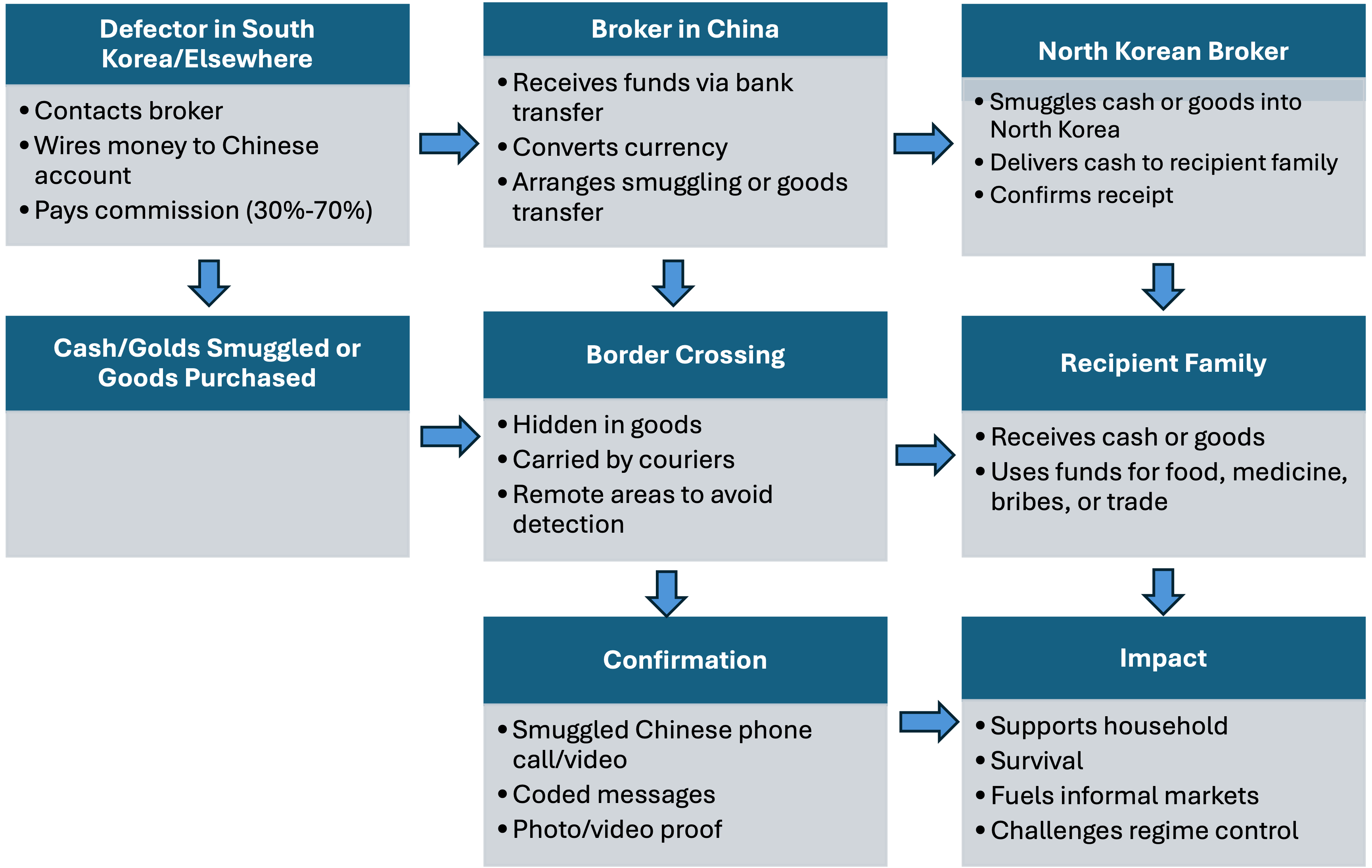
What makes this system remarkable—and precarious—is its near-total dependence on cash. Unlike formal banking systems, which are blocked by international sanctions, cash moves through informal broker networks, often involving smuggled Chinese mobile phones, coded messages, and high-stakes border crossings. Brokers, who operate in South Korea, China, and inside North Korea, charge exorbitant commissions (sometimes 30–70% of the remittance value) to navigate the legal and logistical minefield of transferring moneyFrom the Latin word moneta, nickname that was given by Romans to the goddess Juno because there was a minting workshop next to her temple. Money is any item that is generally accepted as payment for goods and services and repayment of debts, such as taxes, in a particular region, country or socio-economic context. Its onset dates back to the origins of humanity and its physical representation has taken on very varied forms until the appearance of metal coins. The banknote, a typical representati... More into the world’s
Why Cash Dominates: The Limits of Digital Alternatives
- Sanctions and Financial Isolation
North Korea’s formal banking system is cut off from the global economy due to international sanctions, which prohibit financial transactions with North Korean entities. As a result, formal channels—such as wire transfers or digital payments—are nonexistent. While cryptocurrencies and Chinese mobile paymentA transfer of funds which discharges an obligation on the part of a payer vis-à-vis a payee. More systems (like Alipay or WeChat Pay) have emerged as potential workarounds, their use remains limited.
- The Role of China’s Shadow Banking System
China acts as the linchpin of the remittance process, not only as a transit hub for defectors but also as a financial intermediary. Defectors in South Korea or other countries typically wire money to Chinese brokers, who then arrange for cash to be smuggled into North Korea.
The reliance on cash is reinforced by North Korea’s lack of a functional digital financial infrastructure. While Pyongyang has experimented with digital payment systems, these are tightly controlled by the state and inaccessible to most citizens. For families in North Korea, cash remains the only reliable way to access funds without drawing the attention of authorities.
- Trust and VerificationChecking the authenticity. More in a System Without Recourse
Remittances are built on trust—and the constant threat of betrayal. Brokers use smuggled Chinese SIM cards to confirm transactions with recipients, often through coded phone calls or video chats conducted in remote border areas. Families may send photos or videos holding the received cash as proof, but scams are rampant. Without legal recourse, defectors and their families are vulnerable to extortion by brokers or state security agents, who may intercept funds or demand bribes. Physical cash, handed directly to a trusted contact, remains the most tangible guarantee in a system where digital trails can be dangerous.
The Human Cost of Cash Remittances
Flowchart: Typical Remittance Process from Sender to Recipient
- Legal Risks for Senders and Brokers
In South Korea, defectors who send remittances face criminal charges, including fines and imprisonment. South Korean authorities have intensified crackdowns in recent years, disrupting networks and driving transactions further underground. In China, brokers operate in a legal gray zone, risking arrest or deportation if caught by Chinese or North Korean authorities. Inside North Korea, receiving remittances is equally perilous: families caught with foreign currencyThe money used in a particular country at a particular time, like dollar, yen, euro, etc., consisting of banknotes and coins, that does not require endorsement as a medium of exchange. More or contacts abroad can face imprisonment.
- The Burden of Commissions and ExchangeThe Eurosystem comprises the European Central Bank and the national central banks of those countries that have adopted the euro. More Rates
The cost of sending cash is staggering. Brokers’ fees can consume up to 70% of the remittance value, while fluctuating black-market exchange rates further erode the funds’ purchasing power.
- The Regime’s Double Game: Crackdowns and Exploitation
The North Korean government simultaneously cracks down on and profits from remittances. State security agents are known to extort money from brokers and recipient families, demanding a cut in exchange for turning a blind eye. In some cases, brokers are forced to collaborate with authorities, creating a predatory ecosystem where even the act of survival is monetized by the regime. Yet, remittances also undermine state control by fueling North Korea’s informal markets, which have become a critical source of food and goods outside the state’s ration system.
Cash as a Catalyst for Informal Markets
Remittances do more than keep families afloat—they drive economic changeThis is the action by which certain banknotes and/or coins are exchanged for the same amount in banknotes/coins of a different face value, or unit value. See Exchange. More from the ground up. The influx of foreign currency has helped expand North Korea’s informal markets (jangmadang), where private trade flourishes despite official prohibitions. This has several key effects:
- Reduced Dependence on the State: Families with access to remittances can purchase food, medicine, and household goods that the government fails to provide. In some regions, remittances have enabled small-scale entrepreneurship, such as home-based trading or manufacturing.
- Erosion of State Monopolies: By injecting foreign currency into local economies, remittances weaken the regime’s grip on commerce. This has led to a quiet revolution in parts of North Korea, where market activity now rivals state-distributed rations.
- Social Transformation: Women, who dominate the jangmadang, have gained unprecedented economic autonomy, further destabilizing the regime’s patriarchal structures.
However, this economic liberalization comes at a price. The regime tolerates markets when convenient but cracks down harshly during periods of political tension. Remittance networks are often the first targets of these crackdowns, as they represent a direct challenge to Pyongyang’s economic control.
The Future of Cash Remittances: Challenges and Adaptations
- Technological and Geopolitical Pressures
While cash remains dominant, digital methods are slowly emerging. Some defectors use cryptocurrencies or encrypted messaging apps to transfer funds, though these methods are still niche due to technological barriers and surveillance risks. China’s increasing scrutiny of cross-border financial flows—particularly under pressure from U.S. sanctions—could further complicate cash smuggling routes.
- The Role of the Diaspora in Shaping Change
The persistence of cash remittances highlights the resilience of human connections despite political divisions. For defectors, sending money is not just a financial transaction but an act of defiance and solidarity. As one defector told The Washington Times, “This is the only way to keep my family alive. The risks are worth it.”
- Policy Implications: Humanitarian Dilemmas
The international community faces a moral and strategic dilemma: remittances violate sanctions designed to pressure Pyongyang, yet they also prevent famine and alleviate suffering. Some experts argue for humanitarian exemptions that would allow defectors to send small sums without legal repercussions. Others warn that any loosening of sanctions could be exploited by the regime.
The Enduring Power of Cash in a Digital Age
The story of North Korean remittances is a story about the enduring power of cash in a world increasingly dominated by digital finance. In North Korea, where the state seeks to control every aspect of life, cash is not just a medium of exchange but a tool of resistance, survival, and human connection in the face of overwhelming odds.
Yet, the system is fragile. As sanctions tighten, surveillance technology improves, and China’s role as an intermediary becomes more precarious, the future of cash remittances hangs in the balance. For now, they remain a vital lifeline—one that sustains families, fuels markets, and quietly challenges the regime’s authority. Understanding this cash-based economy is not just an academic exercise; it is a reminder of the human cost of isolation and the lengths to which people will go to survive.
For policymakers and humanitarian organizations, the challenge lies in balancing sanctions enforcement with the protection of basic human rights. Ignoring the role of cash in North Korean remittances risks overlooking one of the most critical—if invisible—forces shaping life inside the country. As long as the regime and the international community remain at an impasse, cash will continue to flow, one smuggled bill at a time.