The Cash Barometer: Denaria Europe Defines New Metrics
A measurement gap in the cash debate
The debate on cashMoney in physical form such as banknotes and coins. More suffers a deficit of easily comprehensible data. The relevant figures exist at the ECB, Eurostat and national central banksIn general, the expression refers to the central banks of different countries. More, but no instrument integrates, updates and communicates them in a in a way that is easy to understand for a non-expert. A July 2026 paperSee Banknote paper. More by Denaria Europe argues this gap is both a problem and an opportunity. By building proprietary indicators from public sources, the organisation moves from commentator on other people’s data to producer of data in its own right — with concrete consequences for media attention, legislative citation and peer collaboration.
The paper proposes three instruments designed to work independently or as a complementary system, all built from publicly available or estimable data with a manageable quarterly update burden. Together they cover use, acceptance and social vulnerability, the three axes on which the future of cash is being decided.
-
Cash Health Index for Europe (CHIE)
The first metric is the Cash Health Index for Europe (CHIE), a composite score from 0 to 100 that captures the overall vitality of cash in each country across five dimensions. The rationale is that cash health cannot be reduced to a single data point: a country may have dense ATM networks yet minimal cash use at the point of sale, or high cash use alongside a weakening legal framework.
The CHIE aggregates five sub-indicators through a weighted average, each normalised on a 0–100 scale using the min-max method across the 20 countries of the first edition:
- Cash use at POSAbbreviation for “point of sale”. See Point-of-Sale terminal. More (25%): share of point-of-sale transactions conducted in cash, from ECB SPACE 2024.
- ATM infrastructure (20%): ATMs per 100,000 adult inhabitants, from the World Bank/IMF Financial Access Survey.
- Transactional cash demand (20%): ATM withdrawal operations per inhabitant per year, deliberately avoiding the hoardingThe term refers to the use of cash as a store of value. However, the term has a negative connotation of concealment, and is often used in the context of the war on cash. See Precautionary Holdings. More bias of aggregate banknoteA banknote (or ‘bill’ as it is often referred to in the US) is a type of negotiable promissory note, issued by a bank or other licensed authority, payable to the bearer on demand. More circulation. This variable is currently estimated from ECB PSS aggregates and will be replaced by direct country series.
- Cash acceptance proxy (20%): the inverse of the share of consumers reporting difficulty accessing cash (SPACE 2024).
- Poverty / financial inclusionA process by which individuals and businesses can access appropriate, affordable, and timely financial products and services. These include banking, loan, equity, and insurance products. While it is recognised that not all individuals need or want financial services, the goal of financial inclusion is to remove all barriers, both supply side and demand side. Supply side barriers stem from financial institutions themselves. They often indicate poor financial infrastructure, and include lack of ne... More (15%): the at-risk-of-poverty rate from Eurostat EU-SILC, a proxy for how exposed low-income households are to a cashless transition.
In the first-edition results (Q1 2026), Austria leads decisively at 88.7, driven by Europe’s highest ATM density (168.6 per 100,000), strong cash use (62%) and high acceptance. The Netherlands (27.4) and Belgium (29.7) sit at the bottom — the Netherlands because cash use has collapsed to 22%, Belgium because it records the highest cash access difficulty rate in the euroThe name of the European single currency adopted by the European Council at the meeting held in Madrid on 15-16 December 1995. See ECU. More area.
-
Cash Acceptance Thermometer (CAT)
The second metric is the Cash Acceptance Thermometer (CAT), which answers the most immediate question a citizen can ask: can I pay in cash in my country’s shops? Expressed as a traffic light — GREEN (75–100), AMBER (45–74) or RED (0–44) — alongside a 0–100 score, it is the most directly actionable instrument for advocacy.
The CAT combines three variables: cash POS share as a proxy for merchant acceptance (35%), consumer access ease from SPACE 2024 (40%), and an original legal framework score of 0–4 assessing whether a country has an explicit obligation to accept cash, a sanctioning mechanism, narrow permitted exceptions and a designated enforcement body (25%).
Its most powerful innovation is the Legal-Real Gap (LRG), the distance between the legal framework score and real acceptance. A country with strong legal tenderMoney that is legally valid for the payment of debts and must be accepted for that purpose when offered. Each jurisdiction determines what is legal tender, but essentially it is anything which when offered (“tendered”) in payment of a debt extinguishes the debt. There is no obligation on the creditor to accept the tendered payment, but the act of tendering the payment in legal tender discharges the debt. More law but weak real acceptance is, in the paper’s words, “the story”: the law exists but is not enforced. Germany exemplifies this — its legal score of 3.5 is the joint highest, yet it falls to AMBER because consumer-reported access ease has deteriorated by 9 points since 2022. Belgium is RED despite a legal score of 2.5, entirely due to its 22% access difficulty rate.
A structural advantage of the CAT is that Denaria Europe co-produces a key input — consumer-reported access difficulty — through its own platform and allied network, making the indicator difficult to rebut.
-
Monetary Exclusion Risk Index (MERI)
The third metric is the Monetary Exclusion Risk Index (MERI), which measures not current cash use but vulnerability to its disappearance. Crucially, a high MERI means high risk — the opposite directionality to the CHIE and CAT, which the paper flags for communicators.
The MERI combines four dimensions: demographic vulnerability, the share of population aged 65 and over (30%); economic vulnerability, the at-risk-of-poverty rate (30%); territorial vulnerability, the inverse of ATM density (20%); and pressure on cash, a composite of low cash POS share and weak legal protection (20%).
The Baltic states top the risk ranking — Latvia (76), Lithuania (75.1) and Estonia (72.1) — combining high poverty, significant elderly populations and strong downward pressure on cash. Finland and the Netherlands, usually framed as digital pioneers, appear at positions 6 and 7: their vulnerable populations are most exposed precisely because their cash ecosystems are receding fastest. Austria, the CHIE leader, has the lowest MERI (23.6), showing that strong cash health and low exclusion risk reinforce each other.
A system greater than its parts
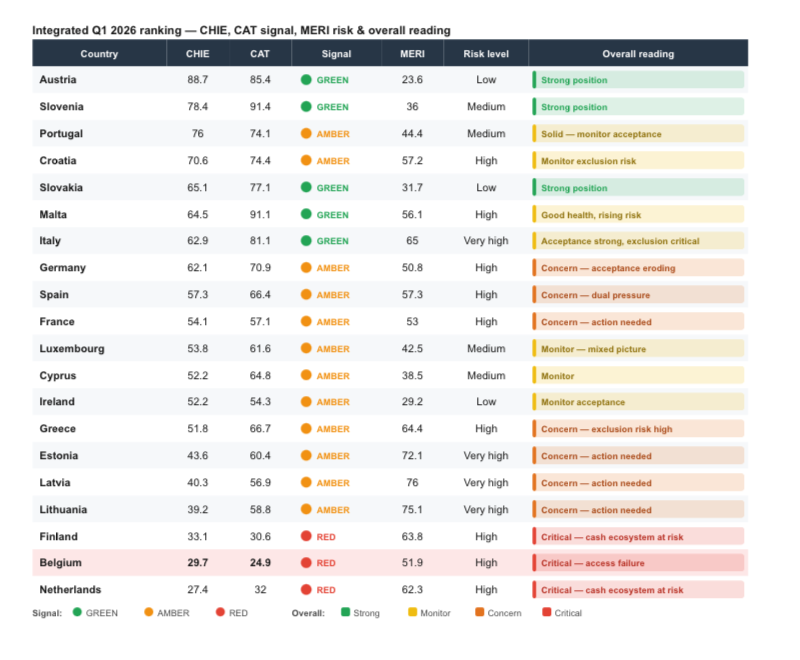
The paper’s central claim is that the three indicators are more powerful together. The chart below reproduces the full Q1 2026 integrated summary across all 20 euro-area countries — CHIE, CAT traffic-light signal, MERI risk level and an overall reading — with red-flag colour coding so the critical and concerning cases stand out at a glance.
Unsurprisingly, Austria tops the chart in the euro area, the only country combining high cash health (CHIE 88.7), GREEN acceptance (CAT 85.4) and low exclusion risk (MERI 23.6). Belgium, which has seen a sharp degradation of its ATM estate and records the highest cash access difficulty rate in the euro area (22% of consumers), sits at the bottom and is labelled “Critical — access failure.” Two other countries — Finland and the Netherlands — are also rated critical (“cash ecosystem at risk”), and seven others are flagged as concerning. The CHIE-MERI paradox — countries scoring lowest on cash health but highest on exclusion risk — offers a counter-narrative to the digital-progress story: Europe’s most cashless countries carry the greatest risk for low-income and elderly citizens. Denaria Europe positions these as original creations with no equivalent in existing literature, registerable and citable, consolidating its role as technical reference for the European cash debate.
First-Edition Results QI – 2026 (20 Countries)
 Source: Denaria Europe, Euroepan Cash Indicators, July 2026