South Africa Counts the Cost of Cash
Why Cash Counts in South Africa
In an economy racing to modernise, it may be tempting to declare cashMoney in physical form such as banknotes and coins. More obsolete. The South African Reserve Bank’s (SARB) new two-part publication — a comprehensive Cost of CashAlthough banknotes are delivered to the citizens free of charge and their use does not involve a specific fee, costs are generated during their manufacturing, storage and circulation process, which are covered by different social agents (central banks, commercial banks, retailers etc). More Research Study and its companion summary report — firmly rejectsBanknotes that are not recognized or are suspected of being counterfeits in automated processing. More that temptation. Cash, the study finds, remains a foundational component of the South African economy, still accounting for roughly 56% of all consumer transactions by volume. It dominates everyday spending, informal markets, and the budgets of cash-reliant households.
That dominance is not nostalgia; it is structural. For millions of South Africans — particularly in rural areas, townships and the informal economy — cash remains the only universally accepted, immediately settled, offline-capable payment instrumentDevice, tool, procedure or system used to make a transaction or settle a debt. More. It requires no bank account, no smartphone, no electricity and no network coverage. The study echoes the SARB’s position paperSee Banknote paper. More “Towards a Cash Smart Society” in recognising that cash and digital payments are not pure substitutes but complementary instruments within a hybrid payments ecosystem: cash provides immediacy, universal acceptance and operational resilience precisely when digital systems are unavailable.
This is why financial inclusionA process by which individuals and businesses can access appropriate, affordable, and timely financial products and services. These include banking, loan, equity, and insurance products. While it is recognised that not all individuals need or want financial services, the goal of financial inclusion is to remove all barriers, both supply side and demand side. Supply side barriers stem from financial institutions themselves. They often indicate poor financial infrastructure, and include lack of ne... More and resilience sit at the heart of the exercise. Any degradation of the cash infrastructure would fall hardest on those least able to absorb it: the unbanked, the elderly, low-income households and informal traders. A payments policy that treats cash simply as a legacy cost to be eliminated risks excluding half the economy.
The cost, in full
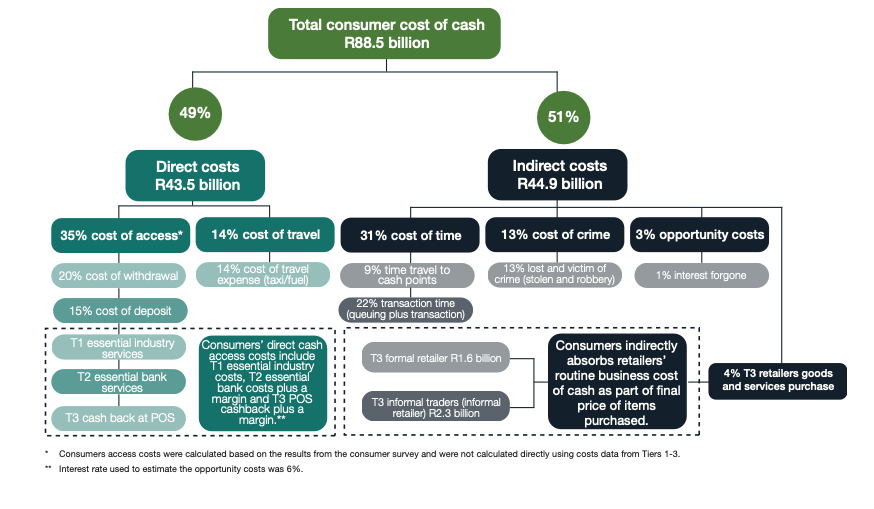
But the continued centrality of cash comes at a price — and for the first time, South Africa knows exactly what it is. Combining quantitative and qualitative methods, and using 2024 as its base year, the study estimates the total annual economic cost of cash at approximately ZAR88.5 billion or USD5 billion, a burden ultimately borne by consumers.
The cost breaks down into two roughly equal halves:
- Direct costs of about ZAR43.5 billion (49%) — withdrawal fees, deposit fees, and travel costs incurred specifically to obtain cash.
- Indirect costs of about ZAR44.9 billion (51%) — travel time, queuing time, transaction time, crime-related costs, forgone interest and other inefficiencies.
Source: A Quantitative and Qualitative Cost of Cash Study (Banknotes and Coins) in South Africa Report, 2026. SARB.
One component deserves particular attention: the economic value of time spent queuing and transacting in cash is estimated at ZAR19.5 billion — 22% of the total, and the single largest indirect cost. Add travel time and out-of-pocket travel costs, and over 45% of the total cost of cash relates to physically getting to the moneyFrom the Latin word moneta, nickname that was given by Romans to the goddess Juno because there was a minting workshop next to her temple. Money is any item that is generally accepted as payment for goods and services and repayment of debts, such as taxes, in a particular region, country or socio-economic context. Its onset dates back to the origins of humanity and its physical representation has taken on very varied forms until the appearance of metal coins. The banknote, a typical representati... More rather than bank fees as such. The burden is sharply regressive: households earning under ZAR1,250 a month spend about 5% of their income on the cost of cash, against 1% for those earning ZAR20,000 or more. The study also dissects the supply side: the three-tier cash value chain — essential industry services (ZAR1.2 billion), essential banking services (ZAR21.6 billion) and retail acceptance including cash-back (ZAR4.3 billion) — incurs direct costs of some ZAR27.1 billion per annum, conceptually embedded within the broader R88.5 billion. Adding the SARB’s own currencyThe money used in a particular country at a particular time, like dollar, yen, euro, etc., consisting of banknotes and coins, that does not require endorsement as a medium of exchange. More production costs (ZAR1.8 billion) brings the cost of supply to roughly ZAR28.9 billion.
The study further reveals a striking shift in how South Africans access cash. Retail cash-back has become the cheapest channel in the country — around 12 cents per ZAR1.53 at bank branches — and now processes about ZAR326 billion in withdrawals across 663 million transactions a year. Field research found shoppers deliberately buying low-cost items with large notes simply to obtain smaller denominations, a workaround exposing a real gap in the system: ATMs cannot dispense coins or small-value changeThis is the action by which certain banknotes and/or coins are exchanged for the same amount in banknotes/coins of a different face value, or unit value. See Exchange. More needed for taxi fares and informal trade.
Why optimisation is the answer
The numbers could easily be weaponised by advocates of a cashless society. The SARB draws the opposite conclusion. Because cash is indispensable to inclusion and resilience, its cost is not an argument for removing it — it is an argument for optimising it. Every rand of the ZAR88.5 billion that can be engineered out of the system is a direct welfare gain for the households that bear those costs today.
This is the logic underpinning the SARB’s Cash Smart Strategy, developed alongside the study and the 2026 position paper. Treating the institution of cash as a system-wide public good to be actively stewarded, the strategy proposes proportionate, activity-based licensing; minimum sector-wide standards for banks and non-bank providers; defined delegation to a national cash utility; and a new regulatory framework for white-label ATMs that could extend affordable access to underserved areas while stripping duplication out of the system.
A toolbox for policymakers
Perhaps the study’s most durable contribution is methodological. Until now, South African policymakers had no comprehensive, evidence-based map of where the costs of cash arise, who bears them, and which levers would reduce them. The study delivers exactly that: a full-value-chain cost accounting, household-level burden analysis, channel-by-channel cost comparisons, and qualitative evidence on user behaviour. It provides a baseline against which the Cash Smart Strategy’s reforms can be measured, and a replicable framework for future updates. In short, it converts a debate often driven by ideology into one driven by evidence.
How it compares internationally
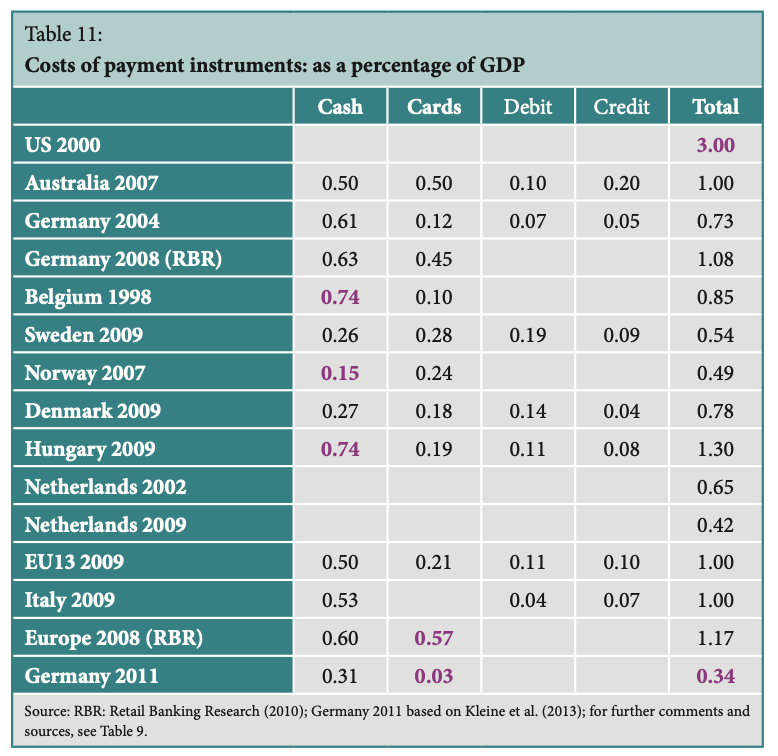
South Africa’s exercise should be read against two decades of cost-of-payments research elsewhere showing how the assumptions and scope of each study drive its conclusions. The tradition began with the central-bank studies of the 2000s — the Netherlands (DNB) and Sweden (Sveriges Riksbank) pioneered the social-cost-of-payments methodology and the concept of “breakeven points” above which card payments become cheaper than cash. More recently, an ECB comparison of nine European studies found that cash was the most expensive paymentA transfer of funds which discharges an obligation on the part of a payer vis-à-vis a payee. More instrument in only one country (Finland, where cash volumes are low); in Germany, Italy and Hungary it was consistently the cheapest, and overall it carried the lowest societal cost per transaction. A 52-country survey by Santiago Carbo-Valverde and Francisco Rodriguez-Fernandez reached a similar conclusion: the unit cost of debit cards was found to be 2.8 times larger than that of cash globally. Krüger and Seitz have compared the findings of costs of payments studies (Costs and Benefits of Cash and Cashless Payment Instruments, Study commissioned by the Deutsche Bundesbank) across 11 geographies with cash costs varying from 0.74% in Belgium and Hungary to 0.15% in Norway (see Table 11).
The SARB study itself benchmarks South Africa’s cost of cash at 1.2% of GDP — in line with other emerging markets such as India (1.7%) and Indonesia (1%) — drawing on its own survey of seven central banks (Austria, Canada, Chile, Germany, Mexico, Namibia and Sweden). Notably, only the advanced-economy central banks had conducted cost-of-cash studies; none of the emerging-market peers had, making South Africa a first mover in its peer group.
What distinguishes the SARB effort is its scope and context. It combines the user-cost lens (fees, travel, time) with the social-cost lens (resource costs across the value chain), adds qualitative field research, and applies both to an emerging economy where cash still dominates by volume — precisely the setting where the international evidence suggests cash is most cost-efficient. And unlike in cash-scarce Finland or rapidly digitising Sweden, the goal is not to accelerate cash decline but to optimise a system treated as public infrastructure. The study even cautions that as cash usage falls, unit costs can paradoxically rise because fixed infrastructure costs persist. For central banks across Africa, Asia and Latin America facing similar hybrid payment realities, the SARB study is likely to become a reference model.
Conclusion
The Cost of Cash study is a landmark: rigorous, transparent about the burdens of cash, and equally transparent about its necessity. Its ZAR88.5 billion headline should not be read as an indictment of cash, but as a call to action. Cash is not the problem; an inefficient cash ecosystem is. With the Cash Smart Strategy in hand and, at last, a precise map of where the costs sit, South Africa is equipped to make its most inclusive payment instrument work better for the people who depend on it most.