Insights from the ECB’s 2026 Survey on Cash Acceptance and Attitudes
What does this mean for businesses, consumers, and policymakers—especially as the EU is planning a regulation on mandatory cashMoney in physical form such as banknotes and coins. More acceptance?
Cash Acceptance: A Steady Rebound
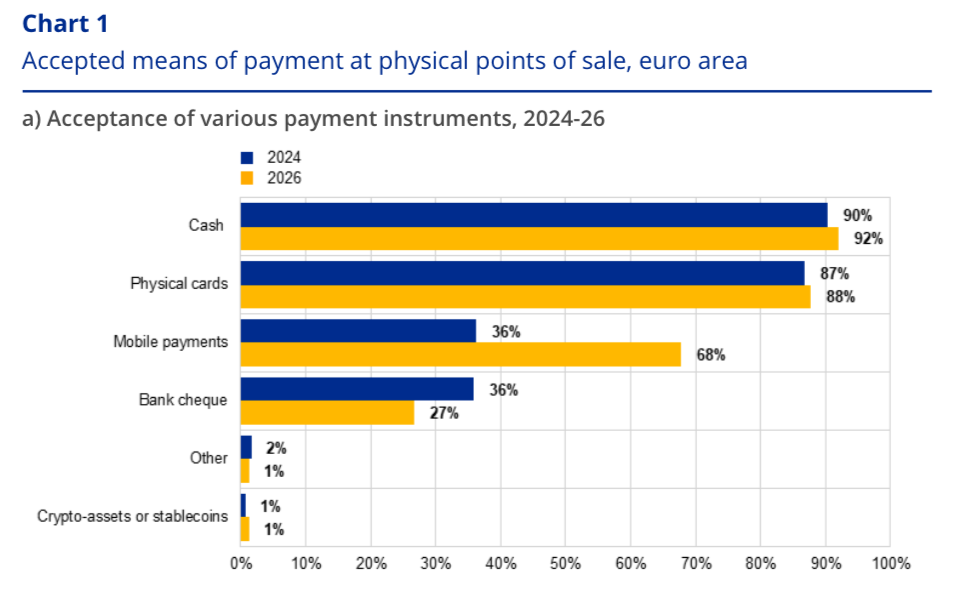
The ECB’s findings mark a turning point. After years of declining cash acceptance—accelerated by the pandemic—2026 shows a small increase at 92%, up from 90% in 2024. This suggests that while digital payments (cards, mobile) have grown, cash remains a non-negotiable option for most businesses. The survey also notes a sharp rise in mobile paymentA transfer of funds which discharges an obligation on the part of a payer vis-à-vis a payee. More acceptance, jumping from 36% in 2024 to 68% in 2026, indicating that companies are diversifying payment options rather than replacing cash.
By Sector: Where Cash Thrives (and Where It Struggles)
Cash acceptance varies significantly across sectors:
- Retail trade, restaurants, and hotels lead with a 93% acceptance rate, reflecting their high-frequency, in-person transactions.
- Arts, entertainment, and recreation lag behind at 84%, though this still represents a majority.
- Petrol stations (96%) and supermarkets are among the most cash-friendly, while sports venues (82%) and non-food specialty stores are less so.
Geographically, Greece and Italy boast near-universal acceptance (99%), while Belgium (81%) and Cyprus (76%)have the lowest rates. The latter’s decline may be influenced by national legislation favoring electronic payments, as well as dissatisfaction with cash-related fees. Interestingly, acceptance is not necessarily higher in countries like France or Spain, where cash acceptance is mandatory.
Why Businesses Still Prefer Cash
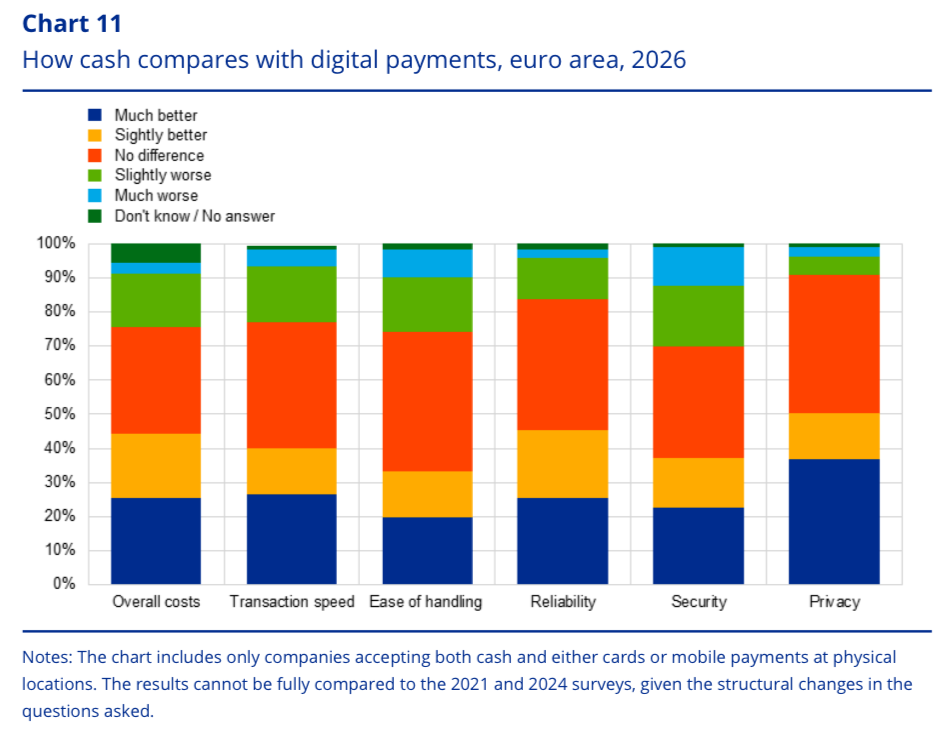
The survey’s most striking finding is that cash outperforms digital payments on every evaluated criterion (Chart 11). When asked to compare cash with digital methods (cards, mobile) across six dimensions—overall costs, transaction speed, ease of handling, reliability, security, and privacy—companies rated cash as superior in all categories, with privacy and reliability standing out as its strongest advantages.
Why Cash Wins on Privacy and Reliability
- Privacy: Cash transactions leave no digital footprint, a feature increasingly valued by both businesses and consumers in an era of data surveillance and cyber risks.
- Reliability: Unlike digital systems, cash never fails due to technical outages, network issues, or power cuts—a critical factor for businesses in remote or infrastructure-challenged areas.
- Cost: While digital payments are often marketed as cheaper, many businesses report that cash incurs lower overall costs, especially when factoring in transaction fees charged by card networks.
- Speed and Ease: Contrary to the stereotype of cash being slow, many businesses find it faster and simpler for small, everyday transactions.
However, the preference for cash is not uniform across all businesses. In particular, there is a negative correlation between company size and cash preference: while SMEs show strong support for cash, larger companies (250+ employees) are less inclined to prefer it.
Concerns About Cash: Mistakes and Security
Despite its advantages, businesses do have concerns:
- 32% worry about mistakes in giving changeThis is the action by which certain banknotes and/or coins are exchanged for the same amount in banknotes/coins of a different face value, or unit value. See Exchange. More.
- 29% cite safety risks (theft, loss).
- 20% are concerned about internal fraud.
Oddly, the survey does not measure the use of cash for e-commerce in spite of solutions such as cash on delivery or the use of QR codes settled at physical locations. This is regrettable given the trend of hybrid channels such as click-and-collect or ride hailing apps which increasingly accept cash.
The Automation Paradox: Self-Checkout and the “Effective Refusal” of Cash
A troubling trend emerges in the survey: 25% of companies have introduced measures to encourage digital payments, and while 13% of companies have introduced self-checkout terminals (SCOs), only 52% of these accept cash. This means that nearly half of SCOs effectively refuse cash, creating a de facto barrier for customers who rely on it.
What This Means for Consumers
- Perception vs. Reality: Even if a store technically accepts cash at manned registers, limiting cash acceptance at SCOs can signal to customers that cash is unwanted, leading to frustration and exclusion.
- Exclusion Risk: This trend disproportionately affects elderly, low-income, or digitally excluded groups who depend on cash.
- Regulatory Implications: As the EU is considering mandatory acceptance, it should extend this to all channels to ensure equal acceptance of cash and digital payments.
Cash Services: The Decline of Cash-in-Transit (CIT) and the Resilience of Bank Counters
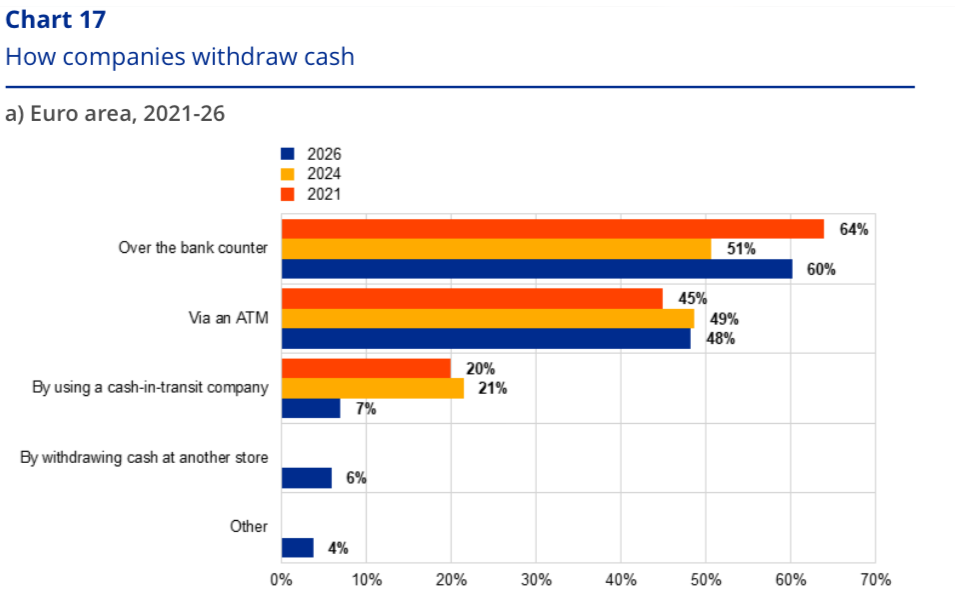
A counterintuitive trend emerges in the survey: while the use of Cash-in-Transit (CIT)Describes the logistical handling of banknotes, coins, and items of value. This can include the transportation, storage, counting and processing, and packaging. Cash-in-transit companies are often responsible for the replenishment and servicing of ATMs. Many cash-in-transit companies are private security companies. See Cash Management Companies. More companies has plummeted for both withdrawals (from 21% in 2024 to just 7% in 2026) and deposits, businesses now increasingly rely on bank branches and ATMs as the primary method (58% for deposits, surpassing cash-in machines at 55%). This shift is particularly concerning given the sharp decline in the number of branches and ATMs, as well as the reduction in branch cash services.
Why the Shift?
- Cost and Convenience: Bank counters are more accessible and often cheaper for SMEs.
- Automation: Companies are adopting smart safes (37%) and automated cash registers (38%), reducing the need for third-party CIT services.
- Security: Businesses may feel more secure handling cash internally with modern safes rather than relying on external logisticsThe term originates from military language and refers to the movement and provisioning of troops at war. In today’s business vocabulary, it refers to the management in particular, the transportation, storage and distribution of finished goods. More.
What the Survey Means for EU Policy
With 92% of physical businesses accepting it, cash has not only stabilized but rebounded from its pandemic-era decline. It is widely valued for privacy, reliability, and cost-efficiency, outperforming digital payments on every frontFacade, face. See Obverse. More.
Yet, challenges remain:
- Self-checkout terminals risk creating a two-tier payment system, where cash is technically accepted but practically discouraged.
- The decline of CIT services could strain cash logistics for businesses, especially if bank branches continue to disappear.
- Regulatory pressure is growing: With some countries – and the EU – considering mandatory cash acceptance laws, businesses may soon have no choice but to ensure full, frictionless cash acceptance—not just at manned registers, but at every point of sale.
For policymakers, the data underscores the need for balanced regulation that:
- Protects cash acceptance without overburdening businesses.
- Encourages inclusive payment infrastructure, ensuring that automation (like SCOs) does not exclude cash users.
- Supports innovative and affordable cash services